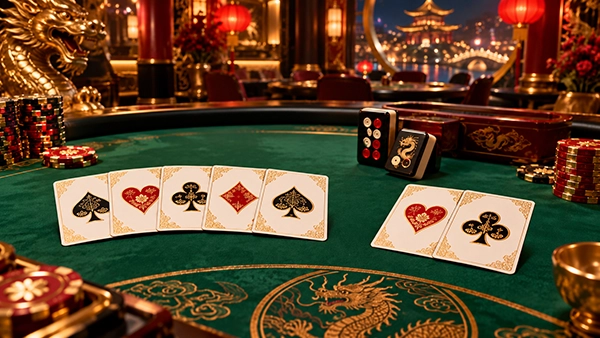
Pai Gow Poker: How Poker Was Combined with a Traditional Chinese Game
Pai Gow Poker looks like a poker table game, yet its structure comes from a very different tradition. The modern game takes the central idea of Chinese Pai Gow — dividing one deal into two separate hands and comparing both with a banker — and rebuilds it with playing cards and familiar poker rankings. That combination explains why a round feels partly recognisable to poker players and partly unlike ordinary poker. Instead of betting through several streets, bluffing or trying to build one final hand, a player receives seven cards at once and decides how to divide them into a five-card high hand and a two-card low hand. As of 2026, this basic format remains the foundation of Pai Gow Poker in casinos and regulated online versions, although details such as commissions, tie rules, side bets and the dealer procedure can vary.
Where Pai Gow Poker Came From
The older game behind the name is Chinese Pai Gow, traditionally played with a set of 32 domino-like tiles. A player receives four tiles and divides them into two pairs, commonly treated as a higher hand and a lower hand. Those two pairs are then compared separately with the banker’s corresponding pairs. Winning both comparisons produces a win, losing both produces a loss, and splitting the comparisons generally leads to no net win on the main contest. The ranking system of the tile game has its own combinations and conventions, so it should not be mistaken for an early form of card poker. What later designers borrowed was mainly its two-hand structure, the contest against a bank and the need to distribute strength between two separate hands rather than concentrate everything in one.
Pai Gow Poker itself is a modern American casino game. Sam Torosian, who managed the California Bell Club in Bell, California, is widely credited with introducing it in 1985. Contemporary Los Angeles reporting from that year records the club seeking and receiving permission to add Pai Gow Poker, while a later account by the Los Angeles Times describes Torosian as the person who developed the game at his card club. The timing is important because it separates the modern card game from the much older Chinese tile game. Pai Gow Poker did not arrive unchanged from China; it was created in California by combining Asian game ideas with Western playing cards and poker-style hand rankings.
The origin story has another useful detail. In a later interview, Torosian said that a Filipino customer told him about Pusoy, a Chinese card game in which a larger group of cards is divided into several poker hands. Torosian considered a simpler two-hand format more suitable for a casino table. The resulting design therefore drew on more than one idea: the split-hand principle associated with Pai Gow, the use of poker cards and poker rankings, and the concept of arranging dealt cards into separate combinations. This helps explain why Pai Gow Poker is best understood as a hybrid rather than a card-for-tile conversion. Its identity comes from the way those elements were reorganised into a short, repeatable banker game.
What the Modern Game Kept from Chinese Pai Gow
The clearest connection is the requirement to create two hands from a single deal. In traditional Pai Gow, four tiles become two pairs; in Pai Gow Poker, seven cards become a five-card hand and a two-card hand. In both cases, the player cannot judge the deal by looking only at the strongest possible combination. A powerful high hand may be less useful if forming it leaves the second hand too weak. The central decision is therefore about balance. This is the feature that gives Pai Gow Poker its distinctive rhythm and separates it from games in which every useful card is simply directed towards one final hand.
The second connection is the use of a banker. Pai Gow has traditionally been played as a comparison against a banking hand, and Pai Gow Poker preserves that basic relationship. In many casino games the house dealer acts as the bank, although some regulated rules also allow player banking or co-banking. Each of the player’s two hands is compared only with the corresponding banker hand: the five-card hand against the banker’s five-card hand and the two-card hand against the banker’s two-card hand. This creates many split results, where the player wins one comparison but not the other. That high frequency of pushes is one reason a Pai Gow Poker session can feel slower than many other casino card games.
What changed was the language used to judge the hands. The complex tile hierarchy was replaced by poker combinations that card players can recognise, such as pairs, two pair, three of a kind, straights, flushes and full houses. A joker was also added to the standard 52-card deck, creating a 53-card pack. Under common regulated rules, the joker is not fully wild in every situation: it normally acts as an ace unless it is used to complete a straight, flush, straight flush or royal flush. This change made the game much easier to present beside other casino card games while preserving the older idea that one deal must be organised into two valid hands.
How a Round of Pai Gow Poker Works
A standard round begins with seven cards being assigned to each active position. The player must make a five-card high hand and a two-card low hand. The high hand must rank at least as strongly as the low hand; setting the two-card hand above the five-card hand creates an invalid arrangement, often called a fouled hand, and is normally treated as a loss. The five-card side uses poker-style rankings, while the two-card side is much simpler because two cards can form only a pair or a high-card hand. The unusual 53rd card is the joker, whose restricted use matters when it appears in combinations involving an ace, straight or flush.
After both sides are set, the player’s hands are compared with the banker’s hands one by one. Under the common form of the game, the player needs to beat the banker in both comparisons to win the main wager. Winning one and losing the other produces a push, so the stake is returned. Losing both means the main wager is lost. Exact ties require particular attention because standard casino rules commonly treat a matching, or copy, hand in favour of the banker. That means a player who ties one side and loses the other normally loses the wager, while tying one side and winning the other can produce a push. The precise wording should always be checked in the rules of the game being played.
Classic Pai Gow Poker commonly pays the main winning wager at even money and deducts a commission, traditionally 5% of the win. That commission is not universal in 2026. Commission-free versions have become common, and they compensate for the removed charge by changing another rule, usually introducing a particular dealer hand that causes the main bet to push. This is why two tables with the same Pai Gow Poker name may not have exactly the same mathematical terms. The basic task of arranging seven cards remains familiar, but the treatment of a winning wager, dealer ties and special push conditions can change the real value of the game.
Why Setting the Two Hands Matters
The main choice in Pai Gow Poker is not whether to draw another card or fold; all seven cards are already known. The choice is how to distribute them. Suppose a deal contains two pairs and three unrelated cards. Keeping both pairs in the five-card hand creates a stronger high hand but may leave the two-card hand with only high cards. Splitting the pairs can strengthen the low hand while weakening the high hand. Neither approach is automatically correct in every situation because the best arrangement depends on the ranks of the pairs, the remaining cards and the rule set. This balance between protecting the high hand and giving the low hand a realistic chance is the main strategic feature of the game.
Casinos solve the same problem through a predefined procedure known as the house way. The house way is a set of instructions telling the dealer how to arrange particular combinations, such as two pairs, three pairs, a full house or four of a kind. It prevents the dealer from choosing a setting arbitrarily after seeing the cards and gives the game a consistent procedure. House ways are not identical everywhere, so a player should not assume that one casino’s dealer would arrange a difficult hand exactly as another casino would. In many venues, a dealer can also show a player how the house would set a hand when assistance is allowed by local rules.
For a beginner, the easiest principle is to remember that both hands matter. Making the strongest possible five-card hand is not the sole objective because the two-card hand must also compete. At the same time, deliberately weakening the high hand too far can turn a promising deal into two mediocre hands. Learning ordinary poker rankings covers most of the recognition needed for the five-card side; the extra work is understanding the joker and practising common splits such as two pair, full house and four of a kind. There is no arrangement that guarantees a win, because the result still depends on the banker’s seven cards and on the particular rules used at the table.
Pai Gow Poker in 2026: Main Variations and Practical Differences
By 2026, Pai Gow Poker is no longer limited to the classic commission game. One of the best-known alternatives is Face Up Pai Gow Poker, where the dealer’s cards are exposed before players complete their own settings. A format that reveals the banker first would normally give the player useful information, so Face Up versions use compensating rules to restore a house advantage. A common approach is to make a specified dealer hand, often an ace-high Pai Gow hand, an automatic push on the main wager. The exact qualifying hand and side-bet treatment can vary, so the name “Face Up” should not be treated as a complete rulebook by itself.
Other versions remove the traditional commission without revealing the dealer first. EZ-style rules, for example, can replace the commission with a special banker result that pushes the main bet. Many tables also offer optional side bets based on all seven cards, including wagers that pay for three of a kind, straights, flushes, full houses, four of a kind or rarer combinations. Fortune-style and envy features are common examples in regulated rule sets. These wagers are separate from the normal two-hand comparison, which means a side bet can have a different result from the main Pai Gow Poker wager. They also have their own payout tables and house margins.
Online versions generally keep the same seven-card split but may present it through computer-generated dealing or a live dealer feed. The important question is not the screen layout but the published rules. A regulated game should explain how the joker works, what counts as a copy hand, whether commission is charged, what special push rules apply and how optional bets are settled. Availability also depends on the country and operator, because Pai Gow Poker is not offered in every regulated market. The underlying game remains recognisable across these formats, but small rule changes can affect both the pace of play and the expected return.
What Players Should Check Before Playing
The first thing to check is the main wager rather than the optional extras. Confirm whether a win pays even money, whether a commission is deducted and what happens when the player and banker make identical hands. If the game is advertised as commission-free or Face Up, read the special dealer-push condition because that rule is usually what replaces the traditional charge. The joker rule should also be stated clearly. In the standard form it has restricted uses, but a different local rule can change which combinations are possible and how a hand should be arranged.
It is also worth separating the main game from side bets. A large side-bet payout table can make rare seven-card hands look important, but those wagers do not change the basic requirement to set a valid five-card and two-card hand. Their probabilities and house margins are calculated separately from the main bet. For someone learning Pai Gow Poker, understanding the two-hand comparison first is more useful than memorising several bonus tables. If a live or online game does not provide clear rules for its extra wagers, there is no reliable basis for judging what the displayed payouts mean.
Finally, the slower pace and frequent pushes should not be confused with an absence of gambling risk. A push merely returns the main stake for that round; it does not create an advantage for the player, and commissions or special banker rules preserve a house edge in regulated casino versions. Setting hands carefully can reduce avoidable mistakes, but it cannot remove randomness or guarantee a positive result. The most accurate way to approach Pai Gow Poker in 2026 is therefore to treat it as a two-hand casino game with clear historical links to Chinese Pai Gow, familiar poker rankings and several modern rule variations that need to be checked before money is staked.